
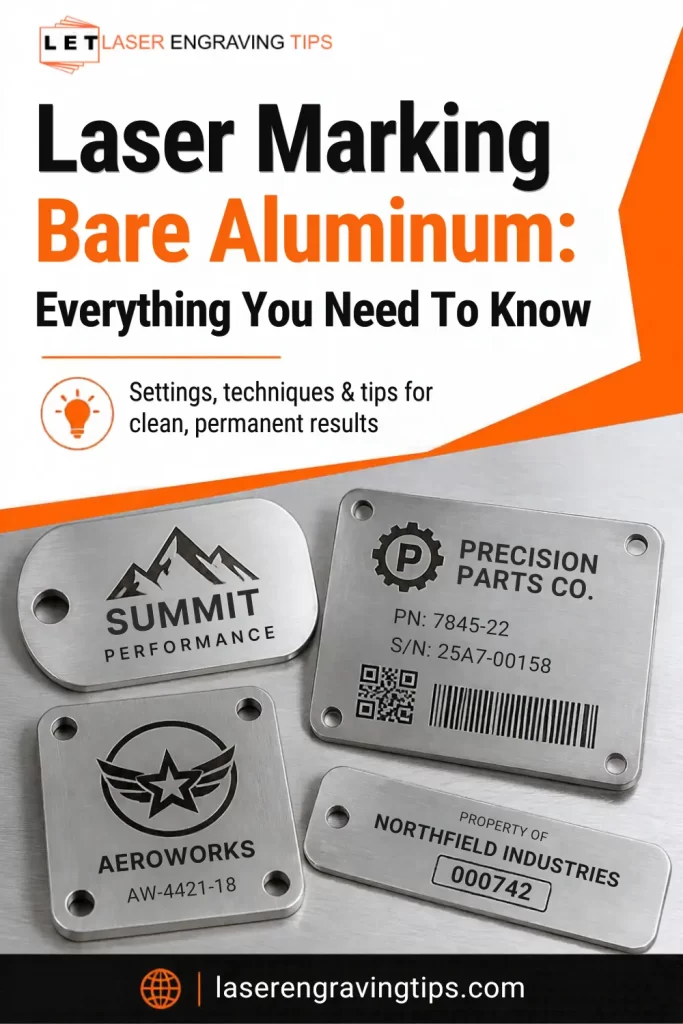
Laser marking bare aluminum is a fast, precise way to add text, logos, serial numbers, QR codes, graphics, and other identification directly onto an aluminum surface.
Unlike anodized aluminum, bare aluminum does not have a colored surface coating that can simply be removed to create contrast.
This means choosing the right laser and processing method is important for producing a clear, durable mark without excessive melting or unwanted surface damage.
Fiber lasers, especially MOPA fiber lasers, are among the most effective options for marking bare aluminum. Depending on the alloy, finish, and desired result, you can create anything from a subtle gray mark to a deeper engraved identification mark.
Table of Contents
This guide explains how laser marking bare aluminum works, which lasers are best, how to choose settings, how to improve contrast, and how to avoid common marking problems.
What Is Laser Marking on Bare Aluminum?
Bare aluminum is aluminum without anodizing, paint, powder coating, or another surface treatment.
When a laser interacts directly with the metal, it can alter the surface through heating, oxidation, melting, vaporization, or controlled material removal.
The exact result depends on the laser wavelength, power, pulse characteristics, speed, frequency, focus, and aluminum alloy.
Laser marking and laser engraving aren’t exactly the same thing. Marking generally aims to create a visible change while keeping the surface relatively shallow. Engraving removes more material and creates a measurable depression.
For many aluminum products, a shallow, high-contrast mark is preferable because it maintains the appearance and structural integrity of the part.
Can You Laser Mark Bare Aluminum?
Yes. Bare aluminum can be laser marked, but it can be more challenging than anodized aluminum.
Aluminum has high reflectivity, particularly at the wavelengths used by some lasers. It also conducts heat quickly, which can make it harder to create a strong contrast without spreading heat into the surrounding area.
A suitable fiber laser can mark many bare aluminum parts effectively. MOPA fiber lasers provide additional control over pulse characteristics, which can be useful when the goal is to produce darker or more controlled surface marks.
The exact result will depend heavily on the alloy and surface finish.
What Is the Best Laser for Bare Aluminum?
Fiber Laser
A fiber laser is one of the most popular choices for bare aluminum because its wavelength is well suited to metal processing.
Fiber lasers can produce precise marks on aluminum with excellent repeatability. They’re commonly used for industrial identification, serial numbers, logos, QR codes, machine parts, tools, and promotional products.
For production work, a fiber laser is usually a better choice than a typical diode laser when bare metal is the primary material.
The Fiber Laser We Recommend for Laser Marking Bare Aluminum: Gweike G2 Max 50W Fiber Laser Engraver

- INDUSTRIAL-GRADE ENGRAVING SPEED: The GWEIKE G2 Max 50W Fiber Laser Engraving Machine Is Equipped With A High-Speed Precision Galvanometer, Achieving An Engraving Speed Of Up To 15000 mm/s And An Accuracy Of 0.001 mm. Its Powerful Performance Significantly Enhances Work Efficiency. Supporting HD 8K Engraving Resolution, It Precisely Captures Every Detail, Delivering An Exceptional Engraving Experience.
For professional laser marking on bare aluminum, the Gweike G2 Max 50W Fiber Laser Engraver is an excellent choice.
Its 50W fiber laser provides the power needed for fast, clean marking on aluminum and other metals, while its precise beam control makes it suitable for detailed logos, serial numbers, QR codes, barcodes, and personalized designs.
The G2 Max is particularly well suited to bare aluminum because fiber lasers are designed for direct metal processing.
With the right settings, you can create permanent, high-contrast marks without relying on paint, coatings, or marking sprays.
For businesses handling aluminum parts, nameplates, tools, promotional products, and custom metal items, the Gweike G2 Max 50W offers a good balance of marking speed, detail, and production capability.
As with any fiber laser, the best results depend on the aluminum alloy, surface finish, lens, and carefully tuned laser parameters.
MOPA Fiber Laser
A MOPA fiber laser is particularly useful when you need greater control over the appearance and characteristics of the mark.
MOPA systems allow adjustment of pulse-related parameters that aren’t available on many standard fiber lasers. This can make it easier to optimize the process for different aluminum alloys and finishes.
MOPA lasers are especially attractive for applications where you need fine details, controlled contrast, color effects on certain metals, or different surface textures.
The MOPA Fiber Laser We Recommend for Laser Marking Bare Aluminum: xTool F2 Ultra 60W MOPA Laser
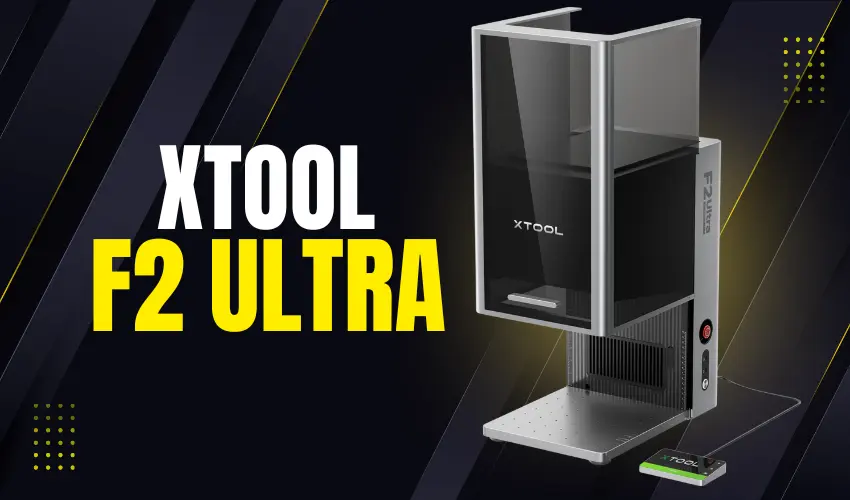
For advanced laser marking on bare aluminum, the xTool F2 Ultra 60W MOPA Laser is an excellent choice.
Its 60W MOPA fiber laser combines high marking power with precise pulse control, giving you more flexibility when optimizing contrast, surface texture, and fine details on aluminum.
The higher power is useful for faster production and deeper marking, while MOPA control allows you to fine-tune parameters such as pulse duration and frequency for different aluminum alloys and finishes.
This makes it well suited for detailed logos, serial numbers, QR codes, barcodes, graphics, and industrial identification.
For businesses that regularly work with bare aluminum and other metals, the xTool F2 Ultra 60W MOPA is a versatile production-focused option.
With the right lens, focus, and material-specific settings, it can deliver consistent, durable marks while giving you greater control over the final appearance than a standard fiber laser.
CO₂ Laser
CO₂ lasers aren’t generally the first choice for directly marking bare aluminum. Aluminum reflects much of the CO₂ laser wavelength, making direct marking difficult and potentially inefficient.
CO₂ lasers can be useful when aluminum has a suitable coating or marking compound, but direct bare-metal marking is typically better suited to a fiber laser.
Diode Laser
A standard diode laser may have limited ability to directly mark bare aluminum because of aluminum’s reflective properties and the wavelength of many diode systems.
Some diode lasers can work with specialized metal marking sprays or coatings. In that situation, the laser is marking the coating rather than producing a conventional direct bare-aluminum mark.
For serious bare-aluminum production work, a fiber laser is generally the more appropriate technology.
How Does a Fiber Laser Mark Bare Aluminum?
A fiber laser concentrates a high-energy beam into a small area on the aluminum surface. As the laser moves across the material, energy is absorbed by the surface and produces a controlled thermal reaction.
Depending on the settings, this can alter the surface appearance, create a texture, remove a small amount of material, or produce a darker oxide-related surface effect.
The goal is to find the processing window where the laser produces a visible mark without excessive melting, splattering, distortion, or deep engraving.
This is why laser parameters matter so much.
Laser Marking Settings for Bare Aluminum
There isn’t one universal setting for bare aluminum.
Two pieces that look almost identical can require different parameters because of differences in alloy, hardness, surface finish, reflectivity, thickness, and manufacturing process.
Important parameters include laser power, marking speed, frequency, pulse duration, hatch spacing, number of passes, focus, and lens selection.
For a MOPA fiber laser, pulse duration can be especially important because it changes how energy is delivered to the surface.
A useful starting point is to create a parameter test grid instead of immediately using production settings. Test different combinations of power and speed, then adjust frequency, pulse duration, hatch spacing, and passes based on the results.
For example, you might test a range of moderate power levels at several marking speeds, then repeat the best-performing area with different pulse parameters.
These should be treated as test ranges rather than universal production settings. Your machine and aluminum alloy may require substantially different values.
Why Is Bare Aluminum Difficult to Mark?
Aluminum presents several challenges for laser marking.
First, it is highly reflective. A portion of the incoming laser energy can be reflected instead of absorbed.
Second, aluminum conducts heat extremely well. Heat can move away from the marking area quickly, which affects the way the surface reacts.
Third, different aluminum alloys can behave very differently. A 6061 part, for example, may respond differently from another alloy or a cast aluminum component.
Finally, surface finish matters. Brushed, polished, machined, bead-blasted, and rough aluminum surfaces can produce noticeably different results.
Because of these variables, testing is an important part of the process.
How to Get Darker Marks on Bare Aluminum
Getting a dark mark on bare aluminum can be more difficult than marking anodized aluminum.
Start by making sure the material is clean and properly focused. Oil, fingerprints, coolant residue, and dirt can interfere with consistent processing.
Next, run a test grid. Adjust power and speed together rather than simply increasing power until the surface becomes damaged.
On a MOPA fiber laser, pulse duration and frequency can also have a significant effect on the appearance of the mark.
Hatch spacing is another important variable. Closely spaced hatch lines can increase the amount of energy delivered to a particular area, while wider spacing can produce a lighter or more textured result.
If your mark becomes shiny, melted, rough, or excessively deep, you’re probably putting too much energy into the material.
Black Marking Bare Aluminum
One of the most common goals is producing a dark or black-looking mark on bare aluminum.
This can be more challenging than producing a gray or frosted mark because aluminum’s surface properties don’t always allow the same high-contrast results you can achieve on anodized surfaces.
A MOPA fiber laser can provide more flexibility for experimenting with pulse duration, frequency, speed, power, and hatch patterns.
The exact mechanism behind the visible dark appearance depends on the material and processing conditions. The mark may involve changes to the surface texture and oxidation characteristics rather than simply removing material.
The best approach is to test a representative sample of the actual aluminum used in production.
Laser Marking Bare Aluminum With Brilliance Laser Inks To Get a Dark Mark
When marking bare aluminum with a fiber laser, you often get white or gray etching. While this works for barcodes, serial numbers, and text, sometimes you need a deep black, high-contrast mark.
That’s where laser marking sprays like Brilliance Laser Inks 12 oz Aluminum Laser Marking Spray – Black come in.
Why Use a Laser Marking Spray?
Bare aluminum naturally reflects a lot of light, which makes it difficult to get a truly black mark with a fiber laser alone.
A marking spray provides a specialized coating that bonds with the metal when hit by the laser, creating a durable, permanent black mark.
Brilliance Laser Inks Aluminum Marking Spray – Key Features

- 𝐀𝐋𝐔𝐌𝐈𝐍𝐈𝐔𝐌 𝐒𝐔𝐑𝐅𝐀𝐂𝐄 𝐒𝐏𝐄𝐂𝐈𝐀𝐋𝐈𝐒𝐓: Our patented nanoparticle technology laser marking spray is formulated to revolutionize permanent high contrast black marking on uncoated 𝐀𝐥𝐮𝐦𝐢𝐧𝐮𝐦 surface
- Deep Black Contrast – Creates crisp, permanent black markings on aluminum that stand out clearly.
- Permanent Bond – Once lasered, the mark is fused into the metal and won’t wipe or wear off.
- Anti-Clog Aerosol – Designed for smooth spraying and long shelf life.
- Laser-Friendly Formula – Specifically made for fiber laser systems, ensuring consistent results.
- 12 oz Can – Plenty of spray for dozens of projects, making it cost-effective.
How to Use Brilliance Laser Inks Spray with a Fiber Laser
- Surface Prep – Clean the aluminum surface with isopropyl alcohol to remove dust, oil, and residue.
- Apply Spray – Shake the can well and spray a thin, even coat over the marking area. Allow it to dry completely.
- Laser Marking – Use your fiber laser with standard marking parameters (start with 60–80% power, 50 mm/s speed, 40–60 kHz frequency). Adjust as needed for your setup.
- Clean Off Residue – After marking, wipe away the unbonded spray with a damp cloth or alcohol. The black marks will remain fused to the aluminum.

Pros and Cons
Pros:
- Produces true black, high-contrast marks.
- Durable and permanent results.
- Easy aerosol application.
- Compatible with most fiber laser systems.
Cons:
- Adds an extra step compared to direct laser marking.
- Consumable cost (spray needs to be replaced when used up).
Applications
Using Brilliance Laser Inks spray makes fiber laser marking suitable for:
- Logos and branding on aluminum products.
- UID codes and barcodes that require maximum contrast.
- Industrial and medical parts where permanent readability is required.
- Custom gifts and personalization for premium finishes.
If you want to achieve dark, high-contrast markings on bare aluminum with a fiber laser, the Brilliance Laser Inks Aluminum Marking Spray is one of the best solutions.
It’s easy to use, delivers professional-quality results, and ensures your markings remain permanent and sharp.
For makers, small businesses, or industrial users, it’s a worthwhile investment when contrast and clarity really matter.
Bare Aluminum Marking vs. Anodized Aluminum
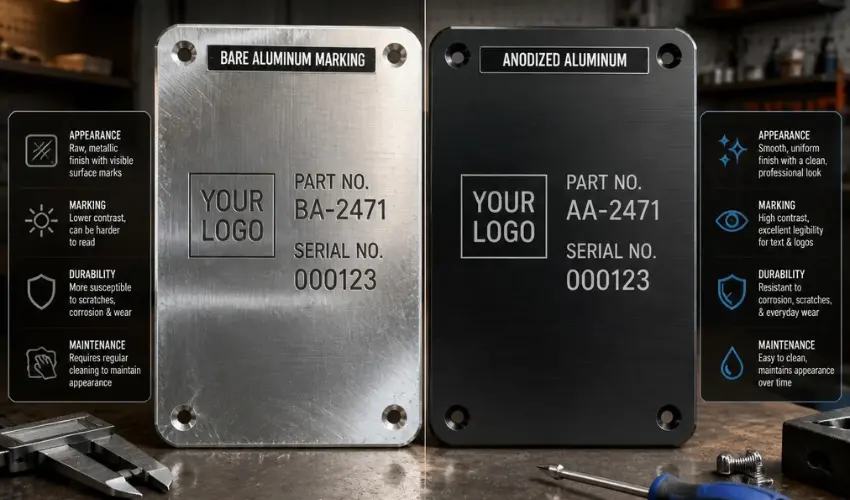
Bare and anodized aluminum behave differently under a laser.
Anodized aluminum has an oxide layer that can be selectively altered or removed. This often makes it relatively easy to create high-contrast marks.
Bare aluminum doesn’t have that same colored anodized layer.
Instead, the laser has to interact directly with the metal surface. This can make contrast more difficult to control, particularly when the desired result is a dark mark without noticeable engraving.
If your application requires very high contrast and you don’t specifically need to mark bare aluminum, anodized aluminum may be easier to process.
Can You Engrave Bare Aluminum?
Yes. Fiber lasers can engrave bare aluminum by removing material from the surface.
Engraving requires more energy than simple surface marking and generally produces a visible depression.
Deeper engraving can be useful for industrial components, machine parts, nameplates, tools, and products that need permanent identification.
However, more power isn’t always better.
Excessive energy can create rough edges, unwanted melting, discoloration, burr-like material, or excessive heat-affected areas.
If the goal is a clean identification mark, a shallow marking process may produce a better result than deep engraving.
Laser Marking Bare Aluminum for QR Codes
QR codes are a popular application for laser marking aluminum.
A fiber laser can produce precise, permanent QR codes that can be used for product identification, inventory tracking, maintenance records, authentication, or access to digital documentation.
The most important consideration is contrast and readability.
A QR code may look acceptable to the human eye but still fail when scanned. Always test the finished code with the scanners or cameras that will actually be used in your application.
Keep the modules clean and well defined, and avoid excessive heat that could distort the edges.
Laser Marking Serial Numbers and Barcodes
Bare aluminum is commonly used for industrial identification plates and components.
A laser can mark serial numbers, model numbers, batch codes, barcodes, part numbers, and other variable information directly onto the surface.
This eliminates the need for labels that can peel, fade, or become damaged during use.
For automated production, laser marking can also be integrated with software and databases so that each part receives unique information.
Laser Marking Logos and Graphics
Laser marking isn’t limited to industrial data.
Bare aluminum can also be marked with company logos, decorative graphics, product names, icons, and personalized designs.
For logos and artwork, resolution and focus become particularly important.
Small details can disappear if the laser spot is too large, the hatch spacing is too wide, or the processing energy is excessive.
A suitable lens and properly calibrated machine can make a noticeable difference when marking fine graphics.
Laser Engraving Photos on Aluminum
Fiber lasers can also be used for certain photographic and grayscale applications on aluminum.
The image is converted into a pattern that controls laser exposure across different areas.
Instead of simply thinking in terms of black and white, the software can use different dot densities, power levels, or processing patterns to create visual tones.
The aluminum surface and desired contrast have a major influence on the final image.
For the best results, prepare the image carefully, use a high-quality source, and test the image-processing settings on scrap material before engraving the final piece.
Preparing Bare Aluminum for Laser Marking
Good surface preparation can improve consistency.
Start by removing dust, grease, fingerprints, oil, and other contamination. Use a suitable cleaning method for the particular part and allow the surface to dry completely before marking.
The aluminum should also be securely positioned so it doesn’t move during processing.
If you’re marking multiple identical parts, a jig can save considerable time and improve alignment.
A well-designed fixture ensures that every part sits in the same position and at the correct focus distance.
Focus Is Extremely Important
Proper focus is essential for clean aluminum marking.
An incorrectly focused beam creates a larger spot and reduces energy density. This can result in weak, blurry, inconsistent, or oversized marks.
If your machine has autofocus, verify that it is correctly measuring the actual workpiece height.
For manual focusing, use the manufacturer’s recommended focal distance and confirm it with a test mark.
When marking curved or uneven parts, maintaining the correct focal position across the marking area can become more difficult.
Choosing the Right Lens
The focusing lens affects both the marking area and the size of the laser spot.
A smaller field lens can provide a smaller spot and higher detail resolution, while a larger field lens gives you a larger working area.
For small text, fine logos, jewelry, and detailed graphics, a smaller marking field may provide better resolution.
For larger signs, plates, or industrial components, a larger lens may be more practical.
Choose the lens based on the physical size of your work and the level of detail required.
Common Problems When Laser Marking Bare Aluminum
The Mark Is Too Light
A weak mark can be caused by insufficient energy, incorrect focus, excessive marking speed, or unsuitable processing parameters.
Rather than immediately increasing power, check focus first. Then test slower speeds or other parameter combinations.
The Aluminum Is Melting
If the surface becomes excessively shiny, rough, or visibly melted, the laser may be delivering too much energy.
Try increasing speed, reducing power, changing pulse parameters, or adjusting hatch spacing.
The Mark Is Uneven
Uneven results can come from inconsistent surface finish, poor focus, contamination, machine calibration issues, or movement during processing.
Make sure the workpiece is clean and secure and that the laser is properly focused.
Fine Details Are Disappearing
Small text and graphics can disappear when the laser is over-processing the material.
Reduce the energy delivered to the surface and check your hatch settings. A smaller marking field or suitable lens may also improve fine detail.
The Surface Is Discolored
Discoloration isn’t necessarily a problem, but it may indicate that the process is creating more heat than intended.
Run a test matrix and experiment with speed, power, frequency, pulse duration, and hatch settings to find a cleaner processing window.
How to Improve Laser Marking Quality
The easiest way to improve results is to stop treating laser parameters as fixed numbers.
Build a material test library.
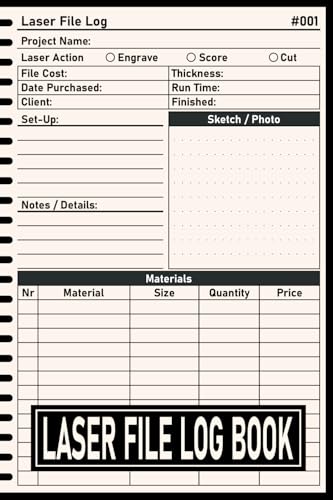

Record the aluminum alloy, surface finish, laser model, power, lens, speed, frequency, pulse duration, hatch spacing, number of passes, and final result.
Over time, this creates a reliable database of settings for your most frequently used materials.
This is especially valuable for businesses because it reduces setup time and makes production more repeatable.
Applications for Bare Aluminum Laser Marking
Laser marking bare aluminum is used in many industries.
Industrial manufacturers use it for serial numbers, part numbers, specifications, logos, and traceability codes.
Automotive companies can mark components with identification and manufacturing information.
Electronics manufacturers can add labels and codes to housings and components.
Tool manufacturers can mark product information directly onto metal surfaces.
Promotional product businesses can personalize aluminum bottles, business cards, tags, plates, and other products.
Aerospace and engineering applications can use permanent laser marking for component identification and traceability, provided the marking process meets the applicable material and industry requirements.
Benefits of Laser Marking Bare Aluminum
One major advantage is permanence. A properly processed laser mark doesn’t rely on ink, stickers, or printed labels.
Laser marking is also highly precise. Fine text, logos, serial numbers, and machine-readable codes can be produced with excellent repeatability.
The process is contactless, so there is no engraving tool physically pressing against the workpiece.
It’s also easy to automate. Variable information can be generated and marked quickly, making laser marking particularly useful for manufacturing and production environments.
Is Laser Marking Bare Aluminum Safe?
Laser marking systems can present serious hazards, especially open-frame or high-power fiber lasers.
Use the appropriate enclosure, interlocks, protective eyewear where required, ventilation or fume extraction, and other safety equipment specified by the laser manufacturer.
Never look directly into the laser beam or reflected beam.
Bare aluminum can produce reflective surfaces, so beam reflections are an important consideration. Keep the work area controlled and make sure the laser is operated according to the manufacturer’s safety requirements.
You should also check the safety data and processing recommendations for any cleaning products, coatings, or marking compounds used during the process.
Tips for Consistent Bare Aluminum Marking
Always test the actual aluminum you intend to use. Don’t assume that a setting that works on one aluminum part will produce the same result on another.
Keep your material clean and your machine properly focused.
Use a test grid whenever you’re working with a new alloy, surface finish, lens, or laser.
If you need a dark mark, experiment with pulse parameters on a MOPA laser rather than simply increasing power.
Use a jig when marking multiple parts.
For QR codes and barcodes, test readability instead of judging the result visually.
Keep records of successful parameters so you can reproduce them later.
Most importantly, optimize for the final result rather than chasing the highest possible power or deepest engraving.
Final Thoughts
Laser marking bare aluminum is an effective way to create permanent identification, branding, personalization, and decorative designs.
While aluminum can be more challenging to process than anodized metal because of its reflectivity and thermal properties, the right laser and properly tuned parameters can produce excellent results.
For direct bare-aluminum marking, fiber lasers are usually the best starting point, while MOPA fiber lasers offer additional control for demanding applications.
The key is testing. Start with a representative piece of aluminum, build a parameter grid, check the result under real production conditions, and record the settings that work.
Once you’ve developed a reliable process for your specific alloy and finish, laser marking bare aluminum can be fast, precise, repeatable, and highly suitable for both small custom projects and professional production.
Frequently Asked Questions
Can you laser mark bare aluminum without coatings?
Yes. Fiber lasers can directly mark bare aluminum by altering its surface microtexture, producing high-contrast white or gray markings. For black marks, you may need a laser additive (like marking spray or ink) that bonds with the aluminum during the process.
What power fiber laser do I need for marking aluminum?
20W – Suitable for etching, logos, barcodes, and light engraving.
30W – More versatile, capable of deeper and darker marks.
50W+ – Best for deep engraving, industrial use, and high-speed production.
Is fiber laser marking on aluminum permanent?
Yes. Fiber laser markings are extremely durable and resist abrasion, heat, and chemical exposure. Unlike printing or labeling, the marks become part of the metal surface, making them long-lasting and tamper-proof.
What’s the difference between etching and engraving on aluminum?
Etching: A shallow, fast process that modifies the surface to create white or gray marks. Great for barcodes, serial numbers, and text.
Engraving: A deeper process that removes material, creating long-lasting marks ideal for parts exposed to heavy wear.
Do fiber lasers require consumables for marking aluminum?
No. One of the biggest advantages of fiber lasers is that they don’t require inks, chemicals, or replacement parts for marking. However, if you want high-contrast black marks, you may choose to use a marking spray or ink, which is optional.
Can a diode laser mark bare aluminum?
A typical diode laser has limited ability to directly mark bare aluminum because aluminum is highly reflective at many diode wavelengths. Specialized coatings or marking sprays can make diode systems useful for coated-metal applications, but a fiber laser is generally a better choice for direct bare-aluminum marking.
What laser is best for marking bare aluminum?
A fiber laser is generally one of the best choices. A MOPA fiber laser provides additional control over pulse characteristics and can be particularly useful when you need to optimize contrast, surface appearance, or fine detail.