
Gold is one of the most popular materials for fine jewelry, luxury accessories, personalized gifts, and decorative products.
Its distinctive appearance and lasting value make it ideal for creating meaningful, customized items. But if you want to add names, initials, dates, logos, or intricate designs to gold, you might be wondering: Can you laser engrave gold?
Yes, you can laser engrave gold. With the right laser engraving machine and carefully selected settings, you can create precise, permanent markings on gold rings, necklaces, bracelets, pendants, and other suitable items. Laser engraving is particularly useful for jewelry businesses that need consistent results and detailed personalization.
However, gold presents several challenges. It reflects certain laser wavelengths, conducts heat efficiently, and is often mixed with other metals to improve durability. Gold-plated jewelry requires even more care because its thin surface layer can be damaged by excessive engraving.
Table of Contents
In this guide, we’ll explain how laser engraving gold works, which laser types are best, how to engrave gold jewelry, and how to achieve clean results without unnecessarily damaging valuable items.
Can You Laser Engrave Gold?
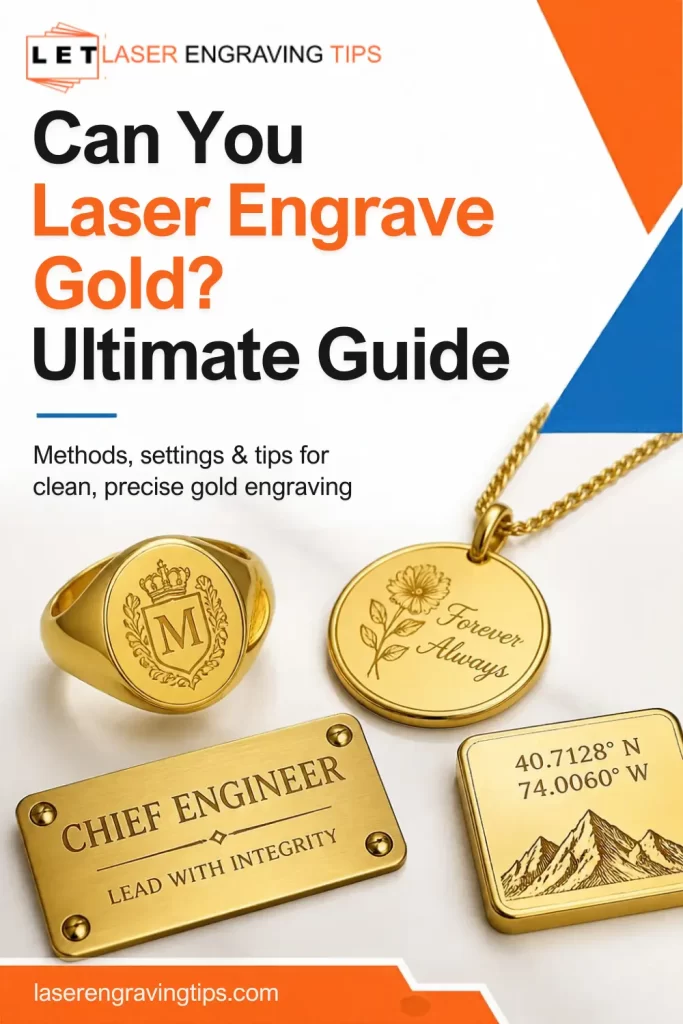
Yes. Gold can be laser marked and engraved using equipment designed for precious-metal processing. The process uses a concentrated laser beam to change the surface or remove a small amount of material, creating text, graphics, or decorative patterns.
The result depends on the type of gold, the laser wavelength, the machine’s capabilities, and the chosen parameters. Some applications require only a shallow surface mark, while others call for a deeper engraving.
Laser engraving is popular for gold jewelry because it can reproduce small details with excellent consistency. Names, initials, wedding dates, short messages, and symbols are common examples.
However, not all gold items respond in the same way. Solid gold, gold alloys, and gold-plated products have different properties, so identifying the material before engraving is essential.
What Is the Best Laser for Gold Engraving?
Choosing the right laser is one of the most important steps in producing a clean engraving. Several laser technologies can process gold, but their suitability depends on the material and desired result.
1. Fiber Laser
Fiber lasers are widely used for metal marking and engraving. A suitable fiber laser can process many gold alloys and create detailed markings on jewelry, tags, plates, and other metal products.
Fiber lasers are commonly used for engraving names, logos, serial numbers, and decorative designs. Their precision makes them useful for small items where accurate positioning and consistent detail matter.
Gold’s reflectivity can make processing challenging, particularly on polished surfaces. Choose a machine suitable for reflective precious metals and follow the manufacturer’s recommendations.
The Fiber Laser We Recommend To Laser Engrave Gold: Gweike G2 Max 50W Fiber Laser Engraver

The Gweike G2 Max 50W Fiber Laser Engraver is an excellent choice for laser engraving gold because it combines high power, precision control, and advanced engraving features that are especially important when working with dense, highly reflective precious metals like gold.
Here’s why it’s a great option:
High-Power 50W Fiber Laser (1064nm)
Gold requires a laser with high energy density to overcome its reflectivity. The Gweike G2 Max’s 50W fiber laser delivers strong, concentrated pulses that gold can absorb efficiently, allowing for clean, crisp engravings without excessive heat damage.
Exceptional Precision for Fine Jewelry Work
With engraving accuracy down to 0.001 mm and support for HD 8K resolution, the G2 Max excels at detailed work such as:
- Jewelry engraving (rings, pendants, bracelets)
- Hallmarks and serial numbers
- Logos, initials, and intricate patterns
This level of precision is ideal for high-value gold items where mistakes aren’t an option.
Deep Engraving & 3D Capabilities
The Gweike G2 Max supports deep engraving and 3D carving, enabling:
- Tactile, high-contrast engravings
- Layered depth effects
- Premium relief-style designs on gold surfaces
This is especially useful for luxury jewelry and custom branding.
Fast Industrial-Grade Engraving Speed
With engraving speeds of up to 15,000 mm/s, the G2 Max allows you to:
- Complete jobs quickly
- Maintain consistent quality
- Increase productivity without sacrificing detail
This makes it suitable for both small businesses and professional workshops.
Excellent Color Marking Control
Gold engraving often benefits from controlled oxidation and surface texture. The G2 Max’s fiber system allows fine tuning of parameters for:
- High-contrast white or dark engravings
- Clean, polished finishes
- Consistent visual results across batches
Large Working Area with Motorized Focus
The 150 × 150 mm (5.91 × 5.91 inches) work area combined with an electric lift column makes it easy to:
- Accurately focus on thin gold jewelry
- Maintain consistent engraving depth
- Reduce setup errors and material waste
Portable & Handheld Flexibility
Despite its power, the G2 Max features a detachable, portable design, allowing:
- On-site engraving
- Engraving directly on finished jewelry pieces
- Greater flexibility compared to fixed benchtop systems
Professional Software Compatibility
The G2 Max works seamlessly with LightBurn and GLaser, giving you:
- Advanced parameter control
- Vector and grayscale engraving support
- Repeatable, professional workflows
Built for Safety & Reliability
Gold engraving requires stable output and safety control. The G2 Max includes:
- Emergency stop
- Protective cover and glasses
- Industrial-grade galvo system for stable beam delivery
2. MOPA Fiber Laser
A MOPA fiber laser is a type of pulsed fiber laser that provides additional control over pulse duration. This flexibility can help operators fine-tune the interaction between the laser and the gold surface.
MOPA systems can be useful when the goal is to control the appearance, detail, or depth of a mark. They are worth considering for professional jewelry personalization and applications involving different metal finishes.
However, MOPA technology doesn’t automatically guarantee a black mark or a particular engraving effect on gold. Results depend on the alloy, laser specifications, surface condition, and processing parameters.
The MOPA Laser We Recommend To Laser Engrave Gold: xTool F2 Ultra 60W MOPA

The xTool F2 Ultra 60W MOPA Fiber Laser is an excellent option for laser engraving gold because it offers exceptional control, power, and precision, all of which are critical when working with precious metals.
Here’s a clear breakdown of why we recommend it:
True 60W MOPA Fiber Laser for Professional Gold Engraving
Gold engraves best with a 1064nm fiber laser, and the F2 Ultra delivers a high-power 60W MOPA system.
Key advantages for gold:
- Direct engraving with no sprays or coatings
- High contrast, permanent markings
- Supports both surface marking and deep engraving
- Excellent results on pure gold and gold alloys
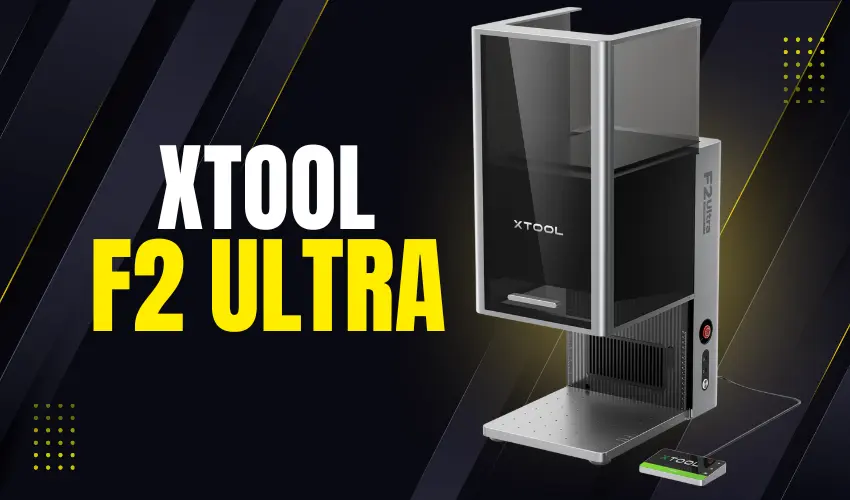
The higher wattage allows faster processing and greater depth control compared to lower-power fiber lasers.
MOPA Technology = Unmatched Control on Gold
MOPA (Master Oscillator Power Amplifier) technology is a major advantage when engraving gold.
Why MOPA matters:
- Adjustable pulse width and frequency
- Precise heat management on soft metals
- Reduced melting, charring, or edge distortion
- Ability to achieve darker, cleaner engravings
This level of control is especially valuable for high-end jewelry and fine detail work.
Superior Detail for Jewelry & Micro Engraving
Gold engraving often requires extremely fine detail and the F2 Ultra excels here.
Perfect for:
- Micro text and serial numbers
- Logos and intricate patterns
- High-end jewelry personalization
- Coin and bullion engraving
The galvo scanning system ensures crisp lines and consistent results across every pass.
Faster Engraving for Business & Production Use
With 60W of power, the F2 Ultra dramatically increases productivity.
Benefits:
- Faster engraving speeds on gold
- Deeper engravings in fewer passes
- Ideal for batch production and commercial workflows
- Less heat buildup due to shorter processing time
This makes it well-suited for jewelry studios and small manufacturing environments.
Excellent Results on Gold-Plated & Multi-Layer Metals
The adjustable pulse settings of a MOPA laser allow you to:
- Fine-tune engraving depth
- Avoid cutting through thin gold plating
- Maintain clean contrast without damaging base metals
This is a major advantage when engraving gold-plated jewelry, watches, and luxury accessories.
Advanced Software & Workflow Compatibility
The xTool F2 Ultra supports professional engraving workflows.
Features include:
- Advanced parameter control for gold
- Preset profiles for faster setup
- Reliable repeatability for production runs
This makes it easy to move from custom one-off pieces to full-scale production.
Long-Term Investment for Precious Metal Engraving
Compared to entry-level fiber lasers, the F2 Ultra offers:
- Greater engraving depth range
- Better consistency across different gold alloys
- Higher resale and professional value
- Scalability as your business grows
It’s built for users who need precision, speed, and flexibility in one machine.
3. 5W Infrared Lasers (Best Budget Option for Gold Engraving)
5W infrared (IR) lasers are an excellent entry-level and budget-friendly option for engraving gold.
Why 5W infrared lasers work well:
- Operate at 1064nm wavelength, just like fiber lasers
- Capable of direct metal engraving (no marking spray needed)
- Lower cost compared to full fiber laser systems
- Ideal for light engraving, logos, and personalization
Best use cases:
- Small jewelry items
- Dog tags and pendants
- Hobbyists and small businesses
- Light surface engraving (not deep cuts)
While not as powerful as industrial fiber lasers, 5W infrared lasers deliver impressive results for beginners and budget-conscious users.
The IR Laser We Recommend To Laser Engrave Gold: xTool F2 5W IR & 15W Diode Portable Dual Laser Engraver
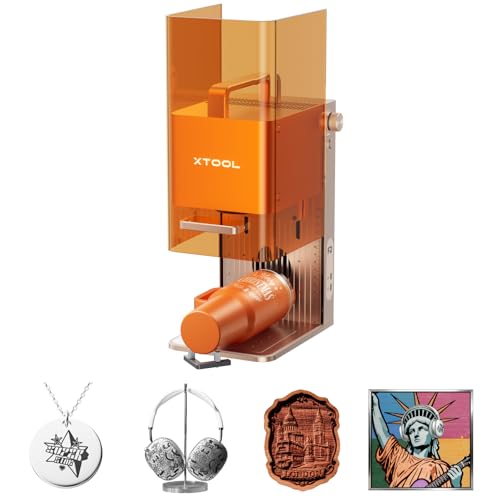

The xTool F2 5W IR & 15W Diode Portable Dual Laser Engraver is a great budget-friendly option for laser engraving gold because it gives you true infrared metal engraving capability at a much lower cost than full fiber laser systems.
Here’s why it’s an excellent choice for beginners, hobbyists, and small businesses:
5W Infrared Laser = Direct Gold Engraving
Unlike standard diode lasers, the 5W 1064nm infrared laser can engrave gold directly.
Why this matters:
- No marking sprays or coatings required
- Permanent, clean engravings on gold
- Works on gold jewelry, coins, and plated items
- Much more effective than visible-light diodes on metals
This alone makes the F2 IR version a standout in the budget category.
Excellent Entry-Level Alternative to Fiber Lasers
Full fiber laser engravers are expensive and overkill for many users. The xTool F2 IR bridges the gap.
Ideal for users who want:
- Metal engraving without fiber laser pricing
- Clean markings without complex setup
- A compact, beginner-friendly solution
You get professional-looking results without the high upfront investment.
Dual-Laser Versatility in One Portable Machine

The combination of 5W IR + 15W diode gives you flexibility that most budget machines can’t match.
What you can engrave:
- Gold and other metals (IR laser)
- Wood, leather, acrylic, coated glass (diode laser)
- Mixed-material projects in one workflow
This makes it perfect for custom gifts, jewelry personalization, and craft businesses.
Safe Engraving on Gold-Plated Items
The lower-power IR laser is especially well-suited for gold-plated or thin gold surfaces.
Advantages:
- Better depth control than high-power fiber lasers
- Reduced risk of burning through plating
- Ideal for watches, pendants, rings, and charms
This level of control is a big plus for delicate items.
Portable & Space-Saving Design
The xTool F2 is designed to be portable and compact, unlike bulky fiber lasers.
Why this matters:
- Easy to move between workspaces
- Ideal for home studios or small shops
- Great for on-site engraving or craft fairs
It’s one of the few gold-capable laser engravers you can realistically carry.
Beginner-Friendly with Professional Software Support
Despite its affordability, the F2 doesn’t sacrifice usability.
Features include:
- Auto-focus and live preview
- Compatibility with xTool Creative Space
- Simple parameter tuning for metals
- Fast learning curve for new users
This makes gold engraving approachable even if you’re just starting out.
Outstanding Value for the Price
For users who don’t need deep metal engraving or high-volume production, the F2 IR offers exceptional value.
Best suited for:
- Jewelry personalization
- Small gold tags and charms
- Name engraving and fine text
- Low- to medium-volume work
It delivers results that rival more expensive systems for many everyday applications.
Lasers NOT Recommended for Engraving Gold
- CO₂ lasers – Cannot directly engrave gold
- Diode lasers – Cannot directly engrave gold
Can You Laser Engrave Solid Gold?
Yes. Solid gold can be laser engraved when the equipment and settings are suitable for the specific alloy.
Pure gold is relatively soft, so jewelry is often manufactured from alloys that improve its strength and durability. Common examples include 10K, 14K, and 18K gold. These grades contain different proportions of gold and other metals, which can influence how they respond to laser processing.
Yellow gold, white gold, and rose gold also differ in composition. As a result, settings that work well on one type may not produce the same appearance on another.
Before engraving valuable jewelry, identify the karat rating and, if possible, the alloy composition. Test on an equivalent material sample whenever possible.
For curved items such as rings and bracelets, accurate positioning and focus are particularly important. A suitable fixture or rotary attachment can help keep the engraving aligned with the surface.
Can You Laser Engrave Gold-Plated Jewelry?
Yes, but gold-plated jewelry requires additional care.
Gold-plated items have a thin layer of gold over a different base material. If the laser removes too much material, it can cut through the gold layer and expose the metal underneath.
This may create a noticeable color difference and permanently damage the item’s finish.
Before engraving plated jewelry, identify the type of plating and assess whether the surface layer is thick enough for the intended process. A shallow marking approach may be appropriate for some products, but testing is essential.
Gold-colored jewelry isn’t always plated with real gold, so appearance alone is not enough to identify the material.
If the item is valuable, antique, sentimental, or has an unknown finish, consult a professional jeweler before engraving it.
What Types of Gold Jewelry Can Be Laser Engraved?
Laser engraving can personalize many types of gold jewelry, provided the surface and dimensions are suitable.
Gold Rings and Wedding Bands
Gold rings can be engraved with names, initials, wedding dates, short messages, and meaningful symbols. Inside-ring engraving requires accurate alignment and equipment suited to the ring’s shape.
Gold Necklaces and Pendants
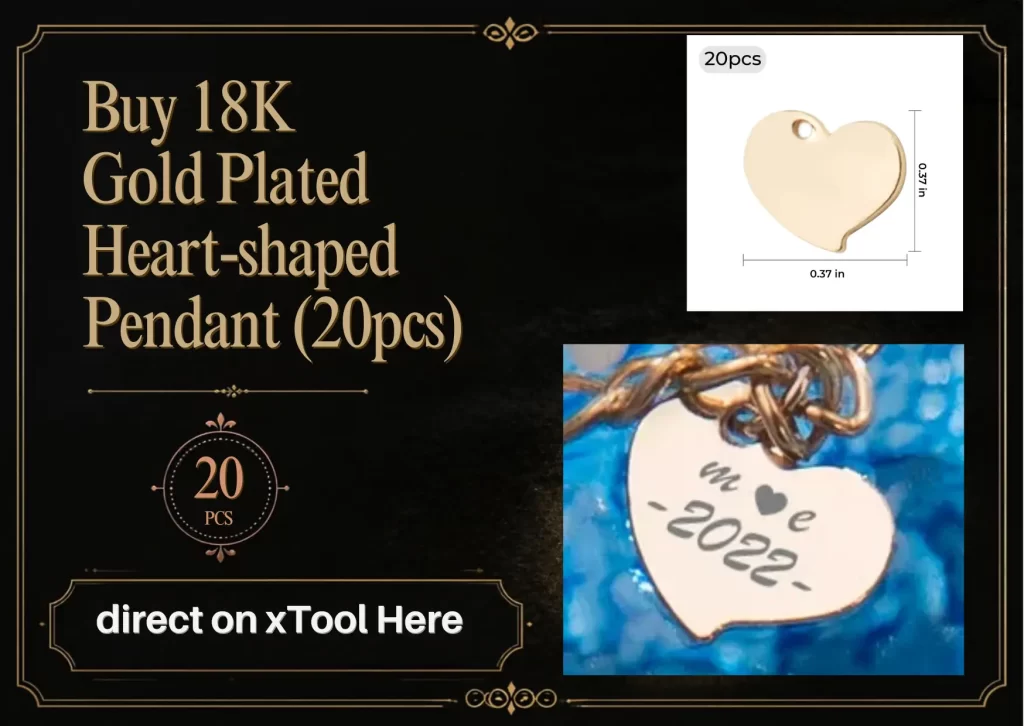
Pendants offer space for initials, dates, small logos, and decorative designs. The available engraving area depends on the pendant’s size, shape, and surface curvature.
Gold Bracelets
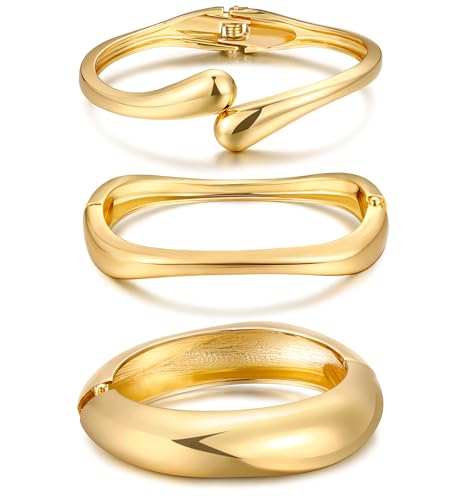
- Sizing Alert: Small inner circumference. Ideal for normal or slender wrists. Not recommended for larger wrists.
Flat bracelets and nameplates are suitable for names, short phrases, and simple graphics. Curved bracelets may need a custom fixture or rotary attachment.
Gold Earrings
Small earrings can be personalized with initials, symbols, or fine decorative marks. Because the engraving area is limited, simple designs and precise focus are particularly important.
Gold Watches and Accessories
Some gold watches, watch backs, and other accessories can be engraved with initials, dates, or personal messages. Check the item’s construction, coatings, and water-resistance requirements before processing. Engraving a watch case may affect its finish or structural features if performed incorrectly.
What Can You Engrave on Gold?
Gold can be personalized with a wide range of designs, including:
- Names, initials, and monograms
- Wedding dates and anniversary messages
- Short quotes and meaningful phrases
- Logos and brand marks
- Decorative patterns and symbols
- Serial numbers and product identification
- Small illustrations and custom artwork
For jewelry, simple designs often deliver the clearest results. Fine lettering and intricate graphics can work, but the design must be scaled to fit the available space and the laser’s resolution.
Always check the final design at its actual engraving size. Text that looks readable on a computer screen may be too small to reproduce clearly on a narrow ring or tiny pendant.
How to Laser Engrave Gold: Step-by-Step Guide
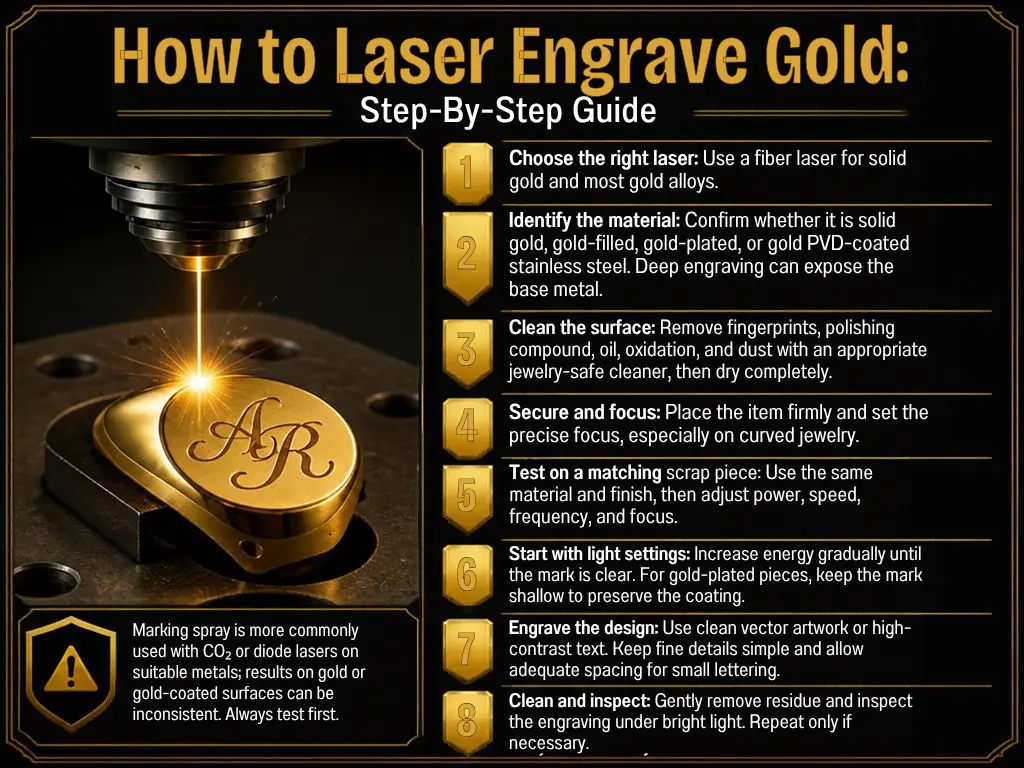
Step 1: Identify the Gold Material
Determine whether the item is solid gold, a gold alloy, gold-plated, or simply gold-colored. If possible, confirm its karat rating and surface finish.
This step helps you choose a suitable process and avoid damaging a thin coating.
Step 2: Clean the Surface
Remove fingerprints, oil, dust, and other contaminants using a cleaning method suitable for the jewelry. Make sure the item is fully dry before engraving.
Avoid abrasive cleaning methods that could scratch polished gold or damage a delicate surface.
Step 3: Prepare Your Design
Use compatible laser software to create the text, logo, or artwork. Vector designs work well for many logos and line graphics, while raster images may be appropriate for supported photographic engraving workflows.
Keep the design within the available engraving area. Use readable fonts and avoid unnecessary detail on small pieces.
Step 4: Secure the Jewelry
Place the item in a stable fixture so it cannot move during processing.
For rings and other curved items, use suitable equipment to maintain alignment across the engraving area. Incorrect positioning can distort text or create inconsistent results.
Step 5: Set the Focus
Focus the laser according to the manufacturer’s instructions. Small jewelry pieces can be sensitive to positioning errors, so verify the focal distance carefully.
If the item is curved, check whether the entire engraving area remains within the laser’s usable focus range.
Step 6: Test the Settings
Use an equivalent material sample whenever possible. Start with conservative settings recommended by the machine manufacturer for the specific gold alloy.
Test the appearance, depth, and readability before engraving the final item. Avoid relying on generic settings charts when working with valuable jewelry.
Step 7: Engrave the Design
Once the test results are satisfactory, position the final item and run the engraving process. Monitor the operation and stop if you notice unexpected discoloration, melting, or surface damage.
Step 8: Inspect and Clean the Item
Check the engraving for clarity, alignment, and consistency. Remove residue using a method suitable for the jewelry and its finish.
If the piece is valuable or you’re unsure whether the process has affected its surface, ask a jeweler to inspect it.
Best Laser Engraving Settings for Gold
There is no universal set of laser engraving settings for gold. The correct parameters depend on the laser type, wavelength, power, pulse characteristics, focus, gold alloy, surface finish, and desired engraving depth.
The main settings include laser power, marking speed, frequency, pulse duration where adjustable, hatch spacing, number of passes, and focus.
Higher power or slower speeds can increase the energy delivered to the surface, but excessive energy can cause unwanted discoloration, melting, or material removal. Multiple passes may provide better control in some applications, but they can also increase heat accumulation.
For jewelry, the goal is often to achieve clear, readable markings while removing as little unnecessary material as possible.
The best approach is to create a test matrix using an equivalent material sample. Change a limited number of parameters at a time, record the results, and use the best-performing combination as the basis for further testing.
Here are safe, proven starting-point laser engraving settings for gold, organized by laser type. These are baseline values meant for test runs, always fine-tune based on gold purity, surface finish, and desired depth.
Always run a small test grid first. Gold reflects heat efficiently, so small setting changes can have big effects
Fiber Laser (20W–60W) – Best Overall for Gold
Best for: Deep engraving, high contrast, production work
Starting Settings
- Power: 30–60%
- Speed: 600–1500 mm/s
- Frequency: 20–60 kHz
- Passes: 1–3
- Focus: 0 to -1 mm (slight defocus for darker marks)
Tips
- Lower frequency = deeper engraving
- Slight defocus improves contrast on polished gold
- Use multiple light passes for plated gold
MOPA Fiber Laser (60W) – Best for Control
Best for: Fine jewelry, color variation, controlled depth
Starting Settings
- Power: 25–50%
- Speed: 800–2000 mm/s
- Frequency: 50–200 kHz
- Pulse Width: 100–200 ns
- Passes: 1–2
Tips
- Adjust pulse width for contrast vs depth
- Shorter pulses = cleaner engraving
- Excellent for logos, micro text, and luxury finishes
Infrared Laser (5W) – Best Budget Option
Best for: Jewelry personalization, light engraving
Starting Settings
- Power: 80–100%
- Speed: 300–800 mm/s
- Passes: 1–3
- Focus: Auto or slightly defocused (-0.5 mm)
Tips
- Use multiple passes for visibility
- Ideal for gold-plated items
- Slower speeds increase darkness
Quick Settings Summary Table
Laser Type | Power | Speed | Passes | Notes |
|---|---|---|---|---|
Fiber | 30–60% | 600–1500 mm/s | 1–3 | Deep, permanent |
MOPA Fiber | 25–50% | 800–2000 mm/s | 1–2 | Best control |
IR (5W) | 80–100% | 300–800 mm/s | 1–3 | Budget-friendly |
How to Get Clean, Detailed Gold Engravings
Producing professional results requires more than choosing a high-powered laser.
Choose suitable equipment. Use a machine designed for the specific gold item and engraving method.
Clean the surface. Contamination can affect marking consistency and appearance.
Focus accurately. Fine text and small logos require correct focus and stable positioning.
Simplify small designs. Remove unnecessary detail when engraving tiny rings, pendants, or charms.
Secure the jewelry. Movement during processing can blur the design or ruin alignment.
Test before production. Confirm the settings on an equivalent sample before working on the final item.
Inspect the result. Check the engraving under good lighting to ensure that the text is readable and the surface finish remains acceptable.
For businesses engraving customer-owned jewelry, documenting successful settings for each material can improve consistency and reduce costly mistakes.
Can You Create Black Marks on Gold?
Dark marks may be possible on some gold alloys with certain laser systems and processing methods, but results vary.
The final appearance depends on the alloy composition, laser wavelength, pulse characteristics, surface finish, and amount of material removed. Some setups produce a contrasting surface texture or altered appearance, while others primarily create a recessed engraving.
A MOPA fiber laser offers additional pulse control that may help optimize the result, but it doesn’t guarantee a black mark on every gold item.
If a particular color or contrast is essential, test the exact alloy and finish before promising the result to a customer.
Laser Engraving Gold vs. Traditional Engraving
Laser engraving and traditional hand engraving can both personalize gold, but they use different techniques.
Laser engraving uses a focused beam of light to alter or remove material. It can reproduce digital artwork and small details with repeatable positioning, making it useful for logos, fine text, and customized production.
Traditional hand engraving uses physical tools controlled by a skilled craftsperson. It can create distinctive cuts and artistic finishes that are valued in certain luxury jewelry applications.
The best option depends on the design, desired appearance, available budget, equipment, and level of craftsmanship required. Some jewelers use both methods for different products.
Laser Engraving Gold vs. Gold-Plated Metal
The main difference is the thickness and composition of the surface being processed.
With solid gold, the laser engraves the gold alloy itself. The practical depth depends on the item’s dimensions and the desired result.
With gold-plated metal, the gold layer is much thinner. Removing too much material can expose the base metal and permanently change the appearance.
If you’re working with plated jewelry, identify the surface layer and test the process carefully. Deep engraving should not be attempted unless the plating and intended result have been properly assessed.
Common Problems When Laser Engraving Gold

The Engraving Is Too Faint
A faint mark may result from unsuitable settings, incorrect focus, or a laser that isn’t appropriate for the material. Check the machine specifications and test alternative settings on an equivalent sample.
The Surface Changes Color
Unexpected discoloration may indicate excessive heat, a reaction involving the alloy, or damage to a surface coating. Stop and reassess the process rather than simply increasing power.
The Engraving Is Too Deep
Excessive material removal can weaken thin jewelry components or alter the finish. Reduce the energy delivered to the surface and test a shallower marking approach.
The Design Looks Blurry
Blurry results may be caused by incorrect focus, movement, excessive energy, or artwork that contains too much detail for the available engraving area. Secure the item and simplify the design if needed.
The Gold Plating Is Damaged
If the laser removes the gold layer and exposes the base metal, the damage may be irreversible without refinishing. Identify plated items before processing and use a suitable shallow-marking method.
Is Laser Engraving Gold Safe?
Laser engraving requires appropriate safety controls, even when working with small jewelry pieces.
Use an enclosed system with appropriate interlocks where required. Follow the manufacturer’s instructions and use wavelength-rated protective eyewear specified for the equipment. Never look directly into the beam or its reflections.
Gold and some gold alloys can reflect laser energy, so the setup must be suitable for reflective metals. Use appropriate fume extraction, particularly if the item contains coatings, solder, plating, or unknown surface treatments.
Do not process unknown materials without identifying them and reviewing their hazards. Keep the workspace controlled and never leave an operating laser unattended unless the system is specifically designed for that use.
Is Laser Engraving Gold Worth It for a Business?
Laser engraving can be a valuable service for jewelry stores, personalized gift businesses, custom accessory makers, and manufacturers.
It allows businesses to offer names, initials, dates, logos, and other personalized designs with repeatable positioning. Digital workflows can also simplify order management and reduce setup time for repeated designs.
However, gold jewelry requires careful handling because mistakes can be expensive. Businesses should account for equipment costs, training, test materials, fixtures, maintenance, and quality control when pricing their services.
Before accepting customer-owned jewelry, establish a clear inspection and approval process. Confirm the material, design, engraving location, and intended result. Explain any limitations involving plating, curved surfaces, and very small text.
Final Thoughts
So, can you laser engrave gold? Absolutely. With suitable equipment and carefully controlled parameters, laser engraving can personalize gold jewelry, reproduce detailed designs, and add permanent identification to selected gold products.
Fiber and MOPA fiber lasers are useful options for many metal-marking applications. The best choice depends on the gold alloy, surface finish, desired appearance, and engraving depth.
The most important step is identifying the material before engraving. Solid gold, gold alloys, and gold-plated items respond differently, and the wrong process can cause costly damage.
Start with a representative test piece, verify the settings, and prioritize detail and surface quality over speed. With the right preparation, laser engraving can deliver precise, professional results while helping preserve the appearance of gold jewelry.
Frequently Asked Questions
Which laser machine is best for gold jewelry engraving?
The best laser machine for gold jewelry engraving is a fiber laser engraver, which offers high precision, speed, and the ability to engrave intricate designs on gold and other metals.
Is gold easy to engrave?
Yes, gold is relatively easy to engrave due to its softness and malleability, making it ideal for detailed and intricate designs using tools like fiber lasers.
Can gold-filled be engraved?
Yes, gold-filled items can be engraved, but care must be taken not to cut too deeply, as it could expose the base metal beneath the gold layer.
Can a 20W fiber laser engrave gold?
A 20W fiber laser may be able to mark or engrave certain gold alloys, depending on its specifications and the desired result. Fine marking may be possible, while deeper engraving can require different parameters or more capable equipment. Test the exact material before selecting a machine for production.
Is a MOPA laser better for gold engraving?
A MOPA laser offers additional control over pulse duration, which can help optimize processing for certain gold alloys. Whether it’s the best choice depends on the material, desired finish, and required engraving depth.
Can you laser engrave a gold wedding ring?
Yes. Gold wedding rings can be engraved with names, dates, initials, and short messages. Inside-ring engraving requires accurate positioning and equipment suited to the ring’s shape and dimensions.
Can you engrave 14K and 18K gold?
Yes. Both 14K and 18K gold can be laser engraved with suitable equipment. Their alloy compositions differ, so the same settings may not produce identical results.
Can you laser engrave gold-plated jewelry?
Yes, but caution is essential. The gold layer may be thin, and engraving too deeply can expose the base metal. Identify the plating and test the process on an equivalent item before engraving valuable jewelry.
Does laser engraving gold reduce its value?
The effect depends on the item, the amount of material removed, and the quality of the work. Personalization may be desirable to the owner, but engraving can affect resale or collector value, especially for antique, branded, or investment pieces. Consider consulting a jeweler before modifying a valuable item.
Can a diode laser engrave gold?
Most standard diode lasers aren’t suitable for directly engraving bare gold. A compatible coating may allow certain marking applications, but equipment designed for precious-metal processing is generally a better choice for direct engraving.
Can laser engraving damage gold jewelry?
Yes. Incorrect settings can cause discoloration, excessive material removal, or damage to plating. Choosing suitable equipment, testing on an equivalent sample, securing the item, and verifying the result can reduce the risk.